Methods of Investigating: Exploring a Tree Through Climbing.For my Methods of Investigating project, I chose a tree as my site of investigation and decided to use climbing and the recording of my movements as my main research method.
When choosing a site, I considered many different possibilities, such as an underground station entrance, a road junction, or even my own room. However, I eventually chose a tree as my research space. The first reason was that a tree, as a natural living organism, does not seem to belong to what we usually understand as a space. The word “space” is often used in architecture and is commonly associated with human-made environments. After exploring many architectural spaces, I suddenly asked myself: why couldn’t I choose a tree as a space to investigate? People rarely think of a tree as a space. This is not only because it does not fit our usual definition of space, but also because it occupies a relatively small area on the ground. We often overlook the vertical dimension of an object because our field of vision is limited. When defining the size of a physical space, we usually focus on its horizontal dimensions, the X and Y axes, which are parallel to the ground, while paying much less attention to the Z axis.
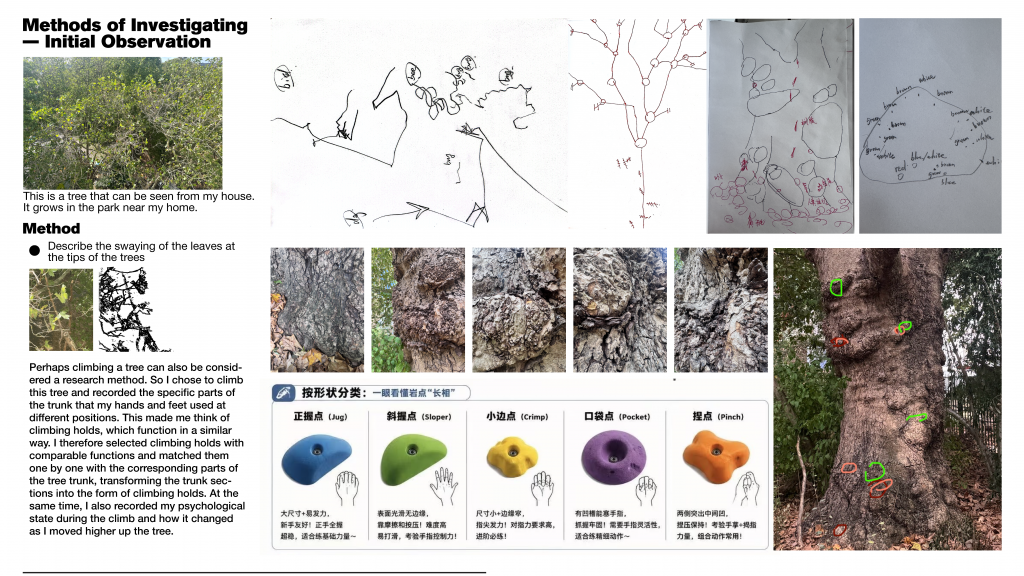
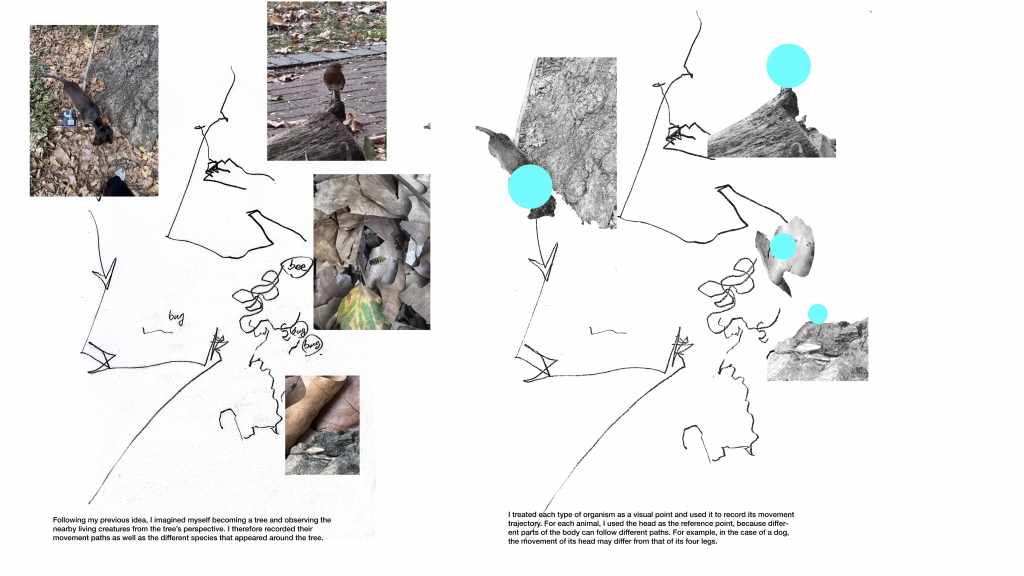
The second reason was the possibility of seeing a tree as a different kind of space. Trees are among the most common things in our daily lives, but we often see them simply as fixed points in our surroundings. A tree is just a tree. We rarely think about how complex and active the life within a tree can be. For some organisms that depend on trees to survive, a single tree might be equivalent to an entire city. This is another reason why I find the idea of a tree as a space so interesting. I eventually decided to investigate the tree by climbing it repeatedly and recording my climbing positions and movements. We usually only see what we are used to seeing. Perec (2008, p. 53) suggests that people tend to notice unusual or extraordinary things while overlooking the ordinary details of everyday life. When I first started investigating the tree, I mainly paid attention to unusual traces left on it, such as bird feathers, dead insects, spider webs, and human rubbish. These were the things that stood out most to me because they seemed out of place on the tree.
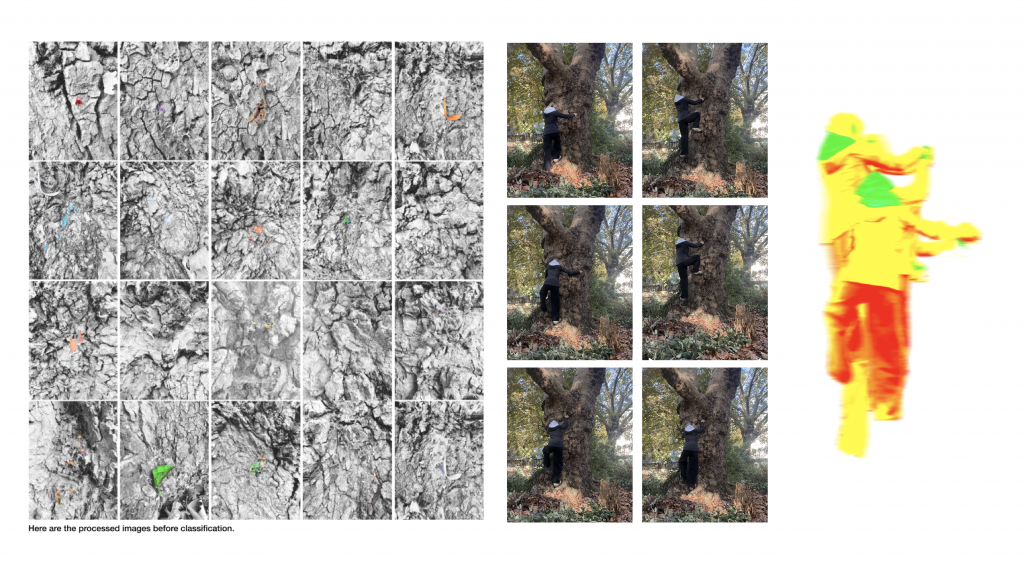
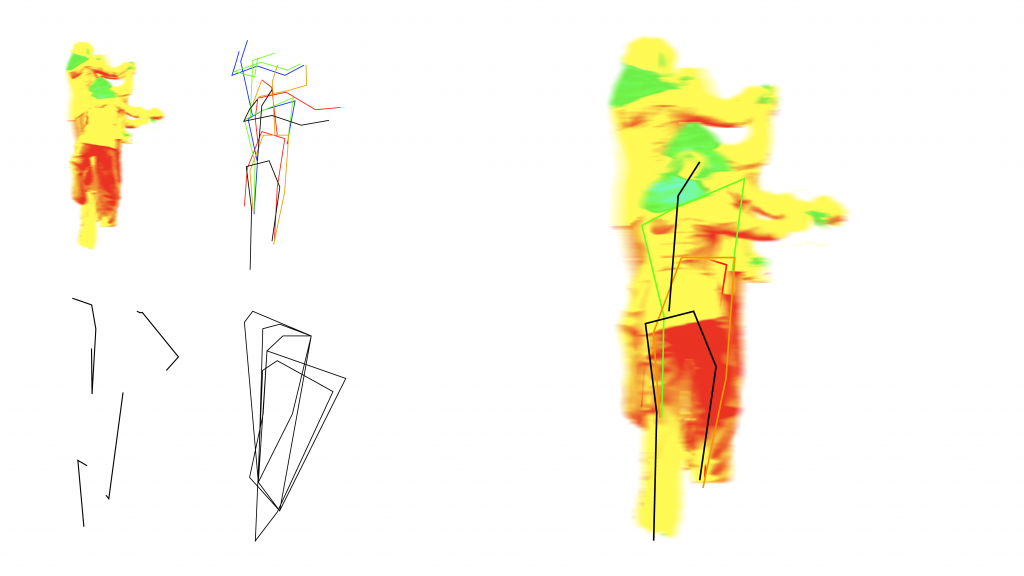
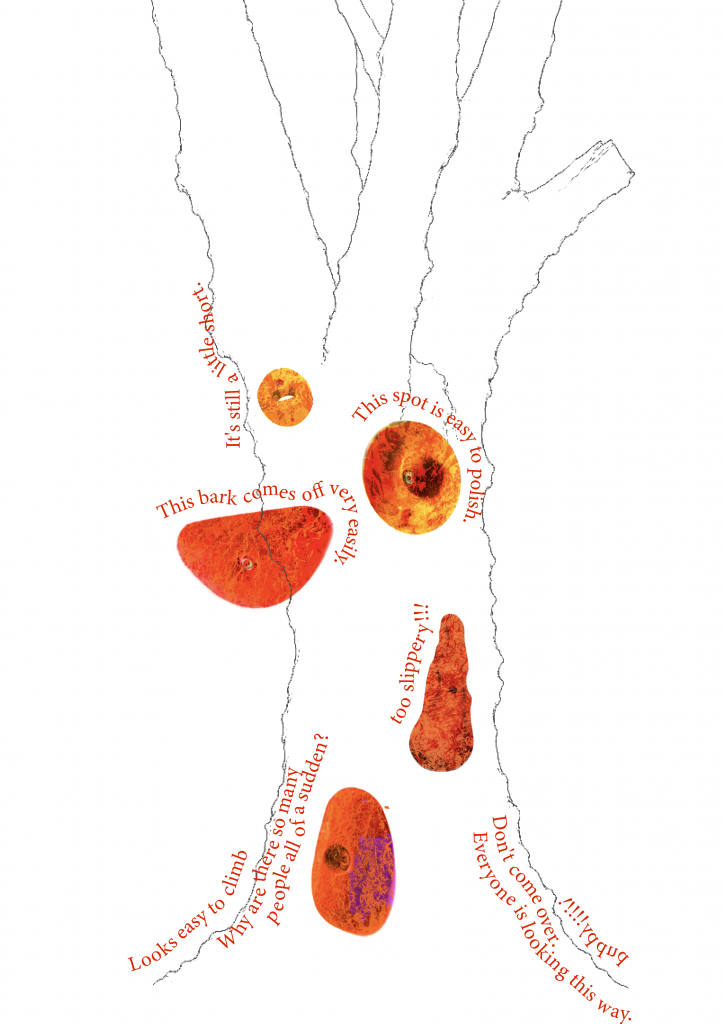
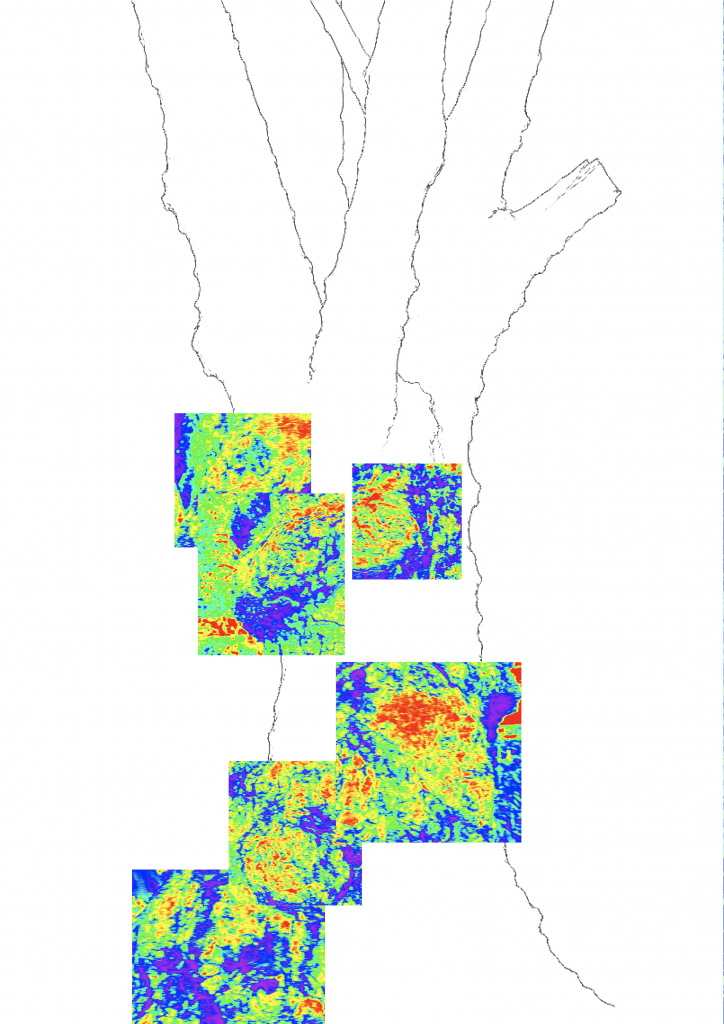
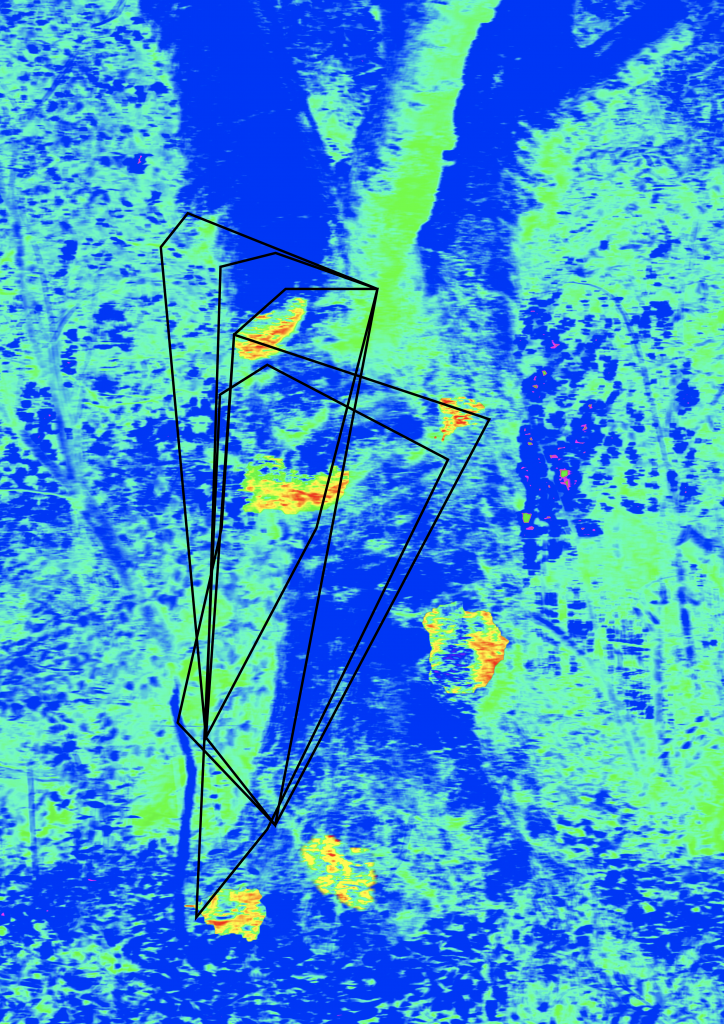
Afterwards, I began to explore the characteristics of the tree itself, from the texture of its bark to the bumps and shapes of its trunk. This made me suddenly wonder: what if I climbed this tree? Many of us have experienced climbing trees as children, but we rarely stop to think about why we climb trees, how we manage to climb them, or which features of a tree make climbing possible. In The Street, Perec (2008, pp. 50–53) asks observers to repeatedly record, classify, count, and wait. He even describes the small actions involved in a driver parking a car. Inspired by this approach, I began climbing the same tree repeatedly, changing the positions of my hands and feet to explore different and potentially better ways of climbing it. I then used photography, handwritten notes, and video recordings to document the process. I recorded the positions of my handholds, how I felt at particular moments, how I gripped different parts of the tree, and how I distributed my body weight. In Mapping It Out: An Alternative Atlas of Contemporary Cartographies, Tehching Hsieh’s map of Manhattan (Obrist, 2014, pp. 74–75) made me think differently about how I could record my climbing experience. Instead of seeing a map simply as a tool for showing locations, I began to consider how lines and marks could represent physical movement. Instead of seeing a map simply as a tool for showing locations, I began to consider how lines and marks could represent physical movement. In my project, I recorded the positions where my hands and feet touched the tree and connected these points to show different climbing routes. This helped me realise that a tree is not only a physical object, but can also be understood as a space shaped by my body’s movements and interactions with it. Eventually, I decided to experiment with thermal imaging as a way of mapping my movements and presenting the climbing process. Of course, my research involved many stages of experimentation and iteration. At first, I simply photographed the points where I climbed and wrote down what I was thinking and feeling at the time. However, I gradually realised that photographs had limitations. They could show the positions of my hands, but they could not fully represent the interaction between my hands and the tree, or clearly demonstrate the different ways I gripped it. I then tried drawing and close-up photography to record these details. Eventually, I chose to experiment with thermal imaging because I thought heat could be transferred from my hands to the tree through repeated contact. In theory, this could reveal not only where I touched the tree, but also suggest how often particular points were used, making it an interesting way to visualise my climbing behaviour. At the same time, I used drawings of my body positions on the tree to show the movement process more clearly. Through these experiments, I began to understand that climbing could become more than a physical activity. It could also be a method of observing, recording, and understanding a space through direct bodily experience.

Leave a Reply