Category: Uncategorised

  • U1 Methods of iterating

    Written Response

    1

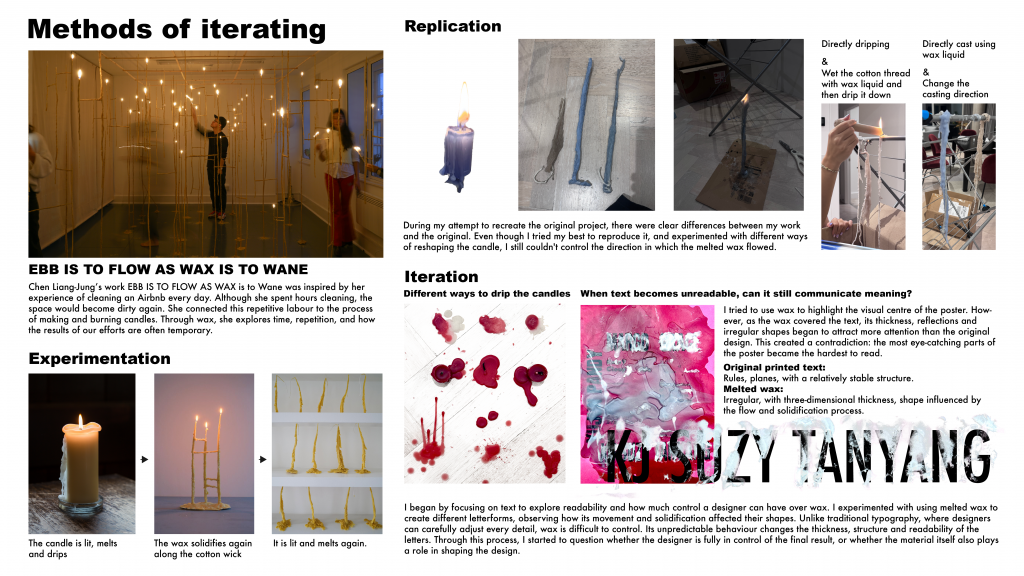
    Beeswax is my main medium, while melting, dripping and solidifying are the processes I use to create my work. I want to explore what happens to the material when I repeat the same actions again and again. What can I control, and what is beyond my control?

    At first, I thought that when liquid beeswax flowed along a cotton string, it would form a relatively even and regular column. However, through experimenting with this process, I realised that the way beeswax flows and solidifies is difficult to fully control. Even when I repeat the same steps, differences in the amount of wax, temperature and where the wax is applied can lead to different shapes.

    What interests me is that these irregular marks are not necessarily failures. Instead, they can become the most interesting features of the work.

    Through studying Liang-Jung Chen’s work, I began to realise that wax is not just a material. The process of changing its physical state can also become a way of creating. Wax flows when heated and solidifies when cooled. This means that the final shape does not always have to be completely decided by the maker in advance. Instead, it can gradually develop through the interaction between the material and time.

    This made me question whether design always needs to begin with a fixed final form, or whether the material itself can also play a role in shaping the result.

    For my next stage, I plan to repeatedly burn and reshape the wax candles. I want to explore how repeated actions influence the material’s form by using different shapes to represent different making times and numbers of repetitions.

    2

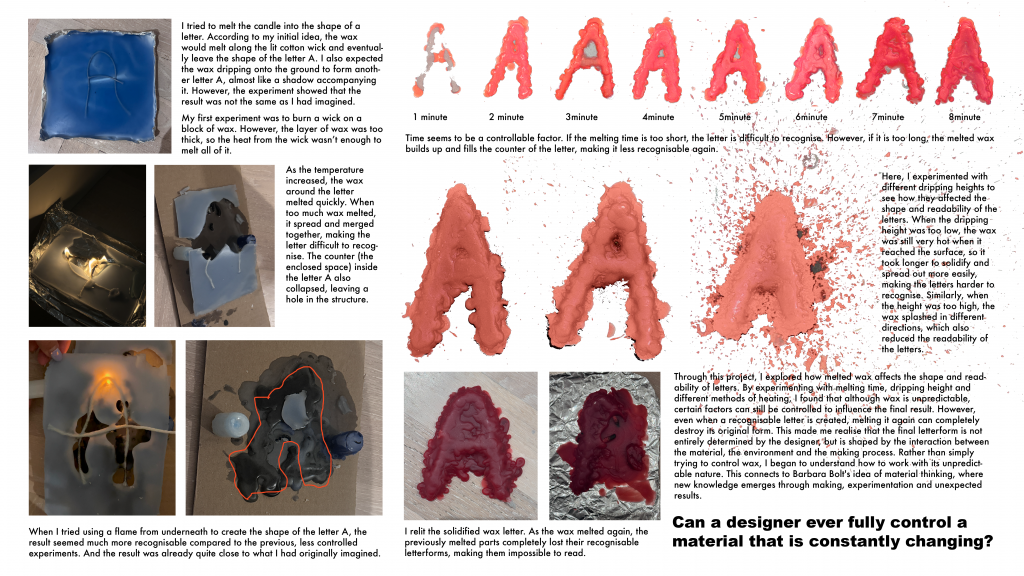
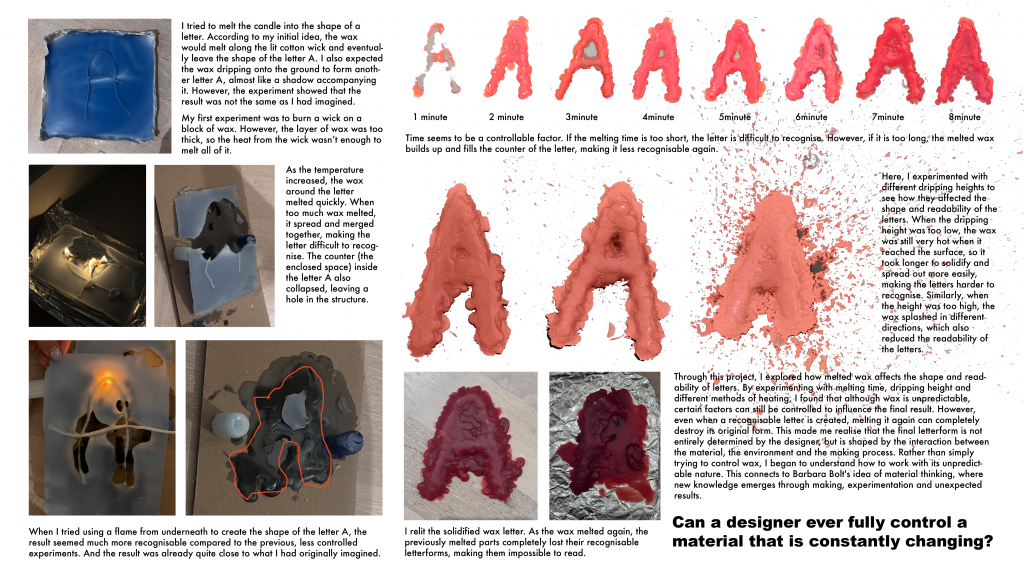
    Inspired by Chen’s project, I started thinking about how the melting and solidifying of wax could be used in type design. I tried placing a wick directly on the surface of a block of wax and lighting it, to see how the heat from the flame would change the original shape of the wax.

    During the experiment, I realised that the melting, flowing and solidifying of wax can create some really interesting visual marks, as well as changing the material itself. This made me wonder: instead of designing letters beforehand, could I develop a new typeface by exploring the shapes that naturally emerge during the burning process?

    I also want to explore how the structure, visual appearance and legibility of letters might change when their forms are influenced by the material and physical processes, rather than being completely controlled by the designer.

     My first experiment was to burn a wick on a block of wax. However, the layer of wax was too thick, so the heat from the wick wasn’t enough to melt all of it.

    I then tried using a thinner layer of wax, but it burned too quickly and didn’t leave many visible marks. So, I’m still experimenting to find the right balance.

    I also tried another approach, which was to use a flame to melt the wax into letter shapes. I found this method really interesting. Visually, the melting process was fascinating because the wax layer was so thin that I could actually see the wax melting as it happened.

    However, I haven’t yet figured out how to develop this into a broader visual exploration.

    I’m also really interested in the letter shapes created in the melted wax itself, as well as the shapes formed by the wax dripping onto the surface below. I think both of these could be interesting starting points for further experimentation.

    After reading the reference literature, I began to explore how answers can be found through practice. During my experiments, I realised that wax is an unpredictable material that exists in two different states. It is difficult to make wax behave exactly as we intend. We cannot fully control where it solidifies or what shape it will take.

    As Heidegger suggests, we do not first come to understand the world through theoretical reflection. Instead, we develop an understanding of the world through practical engagement before we can understand it theoretically. New knowledge can therefore emerge through our interactions with materials, methods, tools and ideas (Heidegger, cited in Bolt, 2007).

    Based on this idea, I decided to explore wax in its different states by experimenting with factors such as the height from which it falls, the speed of movement, burning time and the angle of the paper. Through these experiments, I hope to develop a deeper understanding of the material.

    This connects to Bolt’s discussion of material thinking, which suggests that knowledge does not always exist before making, but can emerge through direct engagement with materials, failure and repeated experimentation (Bolt, 2007).

    For example, in traditional type design, we usually decide on the shape of a letter before using tools to create it. When designing typefaces, we consider legibility, counters, stroke weight, proportions and structure. This often involves a long process of adjustment, because traditional type design places importance on creating a consistent and functional system.

    However, when I use wax as a tool for making letterforms, I lose much of my ability to control these details. Liquid wax does not easily allow me to create sharp corners or precise counters. I cannot maintain an even stroke weight, and when too much wax builds up, the letter may even become unreadable.

    I am not sure whether this can still be called type design. However, through this experimental process, I have begun to realise that the letterform no longer exists entirely according to my intentions. Instead, it is shaped by the interaction between myself, the wax, physical conditions and even the surrounding environment. 

    This leads me to another question:  What happens to the meaning of text when it is created in this way?

    Text no longer seems to function only as a medium for carrying and communicating human knowledge and culture. Instead, it begins to feel like something with its own agency, capable of expressing itself beyond the designer’s complete control. If the material has a role in shaping the letterform, where does the designer’s authorship begin and end?
  • U1 Methods of Investigating

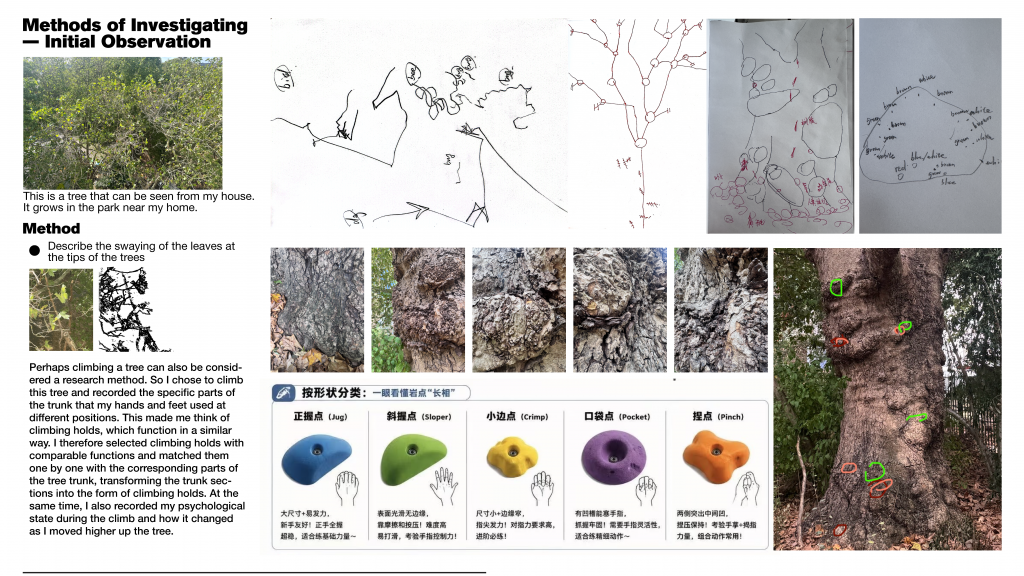
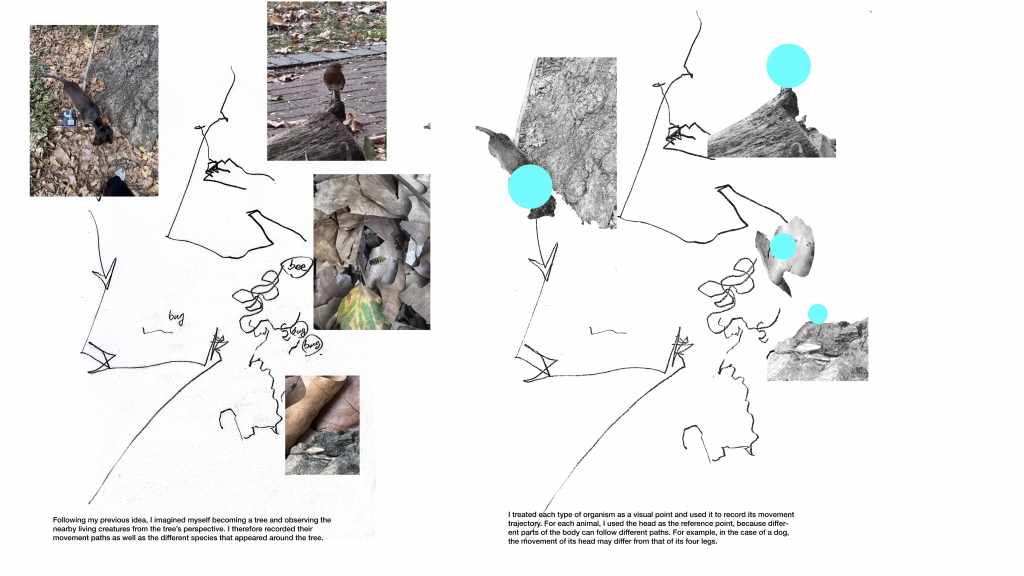
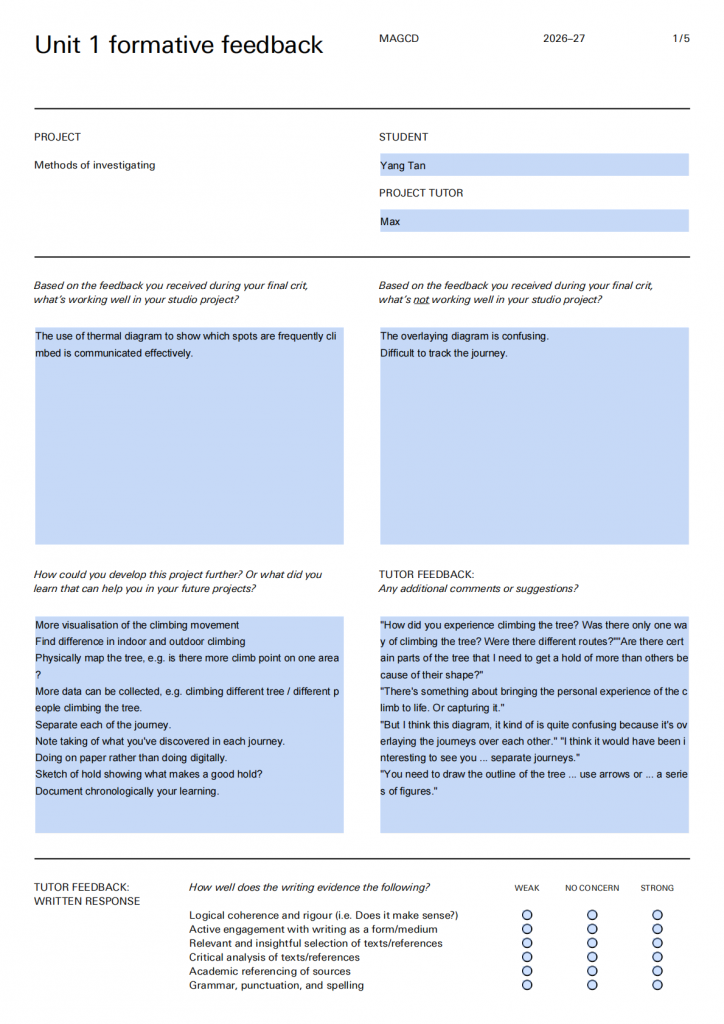
    Methods of Investigating: Exploring a Tree Through Climbing.For my Methods of Investigating project, I chose a tree as my site of investigation and decided to use climbing and the recording of my movements as my main research method.

    When choosing a site, I considered many different possibilities, such as an underground station entrance, a road junction, or even my own room. However, I eventually chose a tree as my research space. The first reason was that a tree, as a natural living organism, does not seem to belong to what we usually understand as a space. The word “space” is often used in architecture and is commonly associated with human-made environments. After exploring many architectural spaces, I suddenly asked myself: why couldn’t I choose a tree as a space to investigate? People rarely think of a tree as a space. This is not only because it does not fit our usual definition of space, but also because it occupies a relatively small area on the ground. We often overlook the vertical dimension of an object because our field of vision is limited. When defining the size of a physical space, we usually focus on its horizontal dimensions, the X and Y axes, which are parallel to the ground, while paying much less attention to the Z axis.

    The second reason was the possibility of seeing a tree as a different kind of space. Trees are among the most common things in our daily lives, but we often see them simply as fixed points in our surroundings. A tree is just a tree. We rarely think about how complex and active the life within a tree can be. For some organisms that depend on trees to survive, a single tree might be equivalent to an entire city. This is another reason why I find the idea of a tree as a space so interesting. I eventually decided to investigate the tree by climbing it repeatedly and recording my climbing positions and movements. We usually only see what we are used to seeing. Perec (2008, p. 53) suggests that people tend to notice unusual or extraordinary things while overlooking the ordinary details of everyday life. When I first started investigating the tree, I mainly paid attention to unusual traces left on it, such as bird feathers, dead insects, spider webs, and human rubbish. These were the things that stood out most to me because they seemed out of place on the tree. 

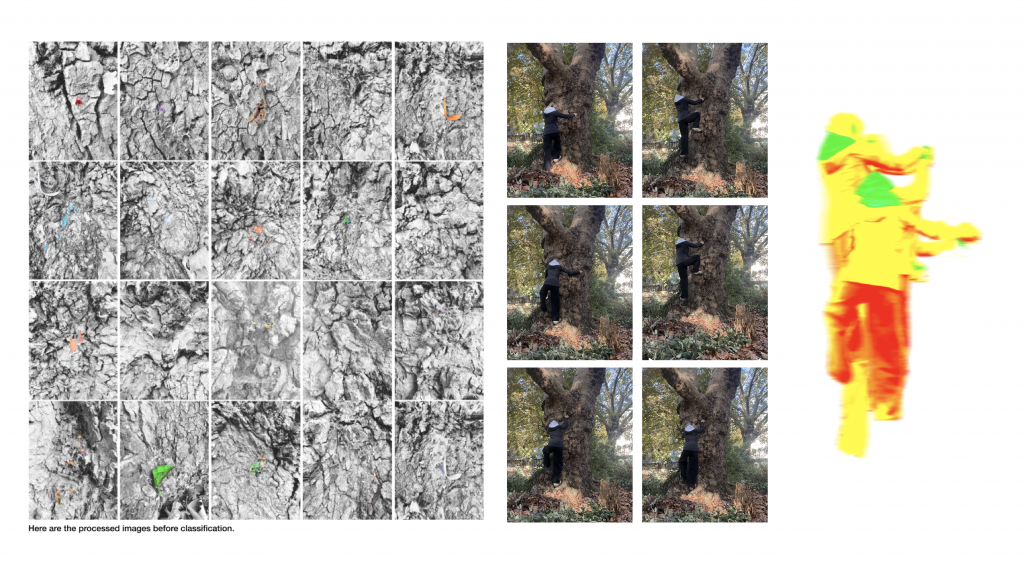
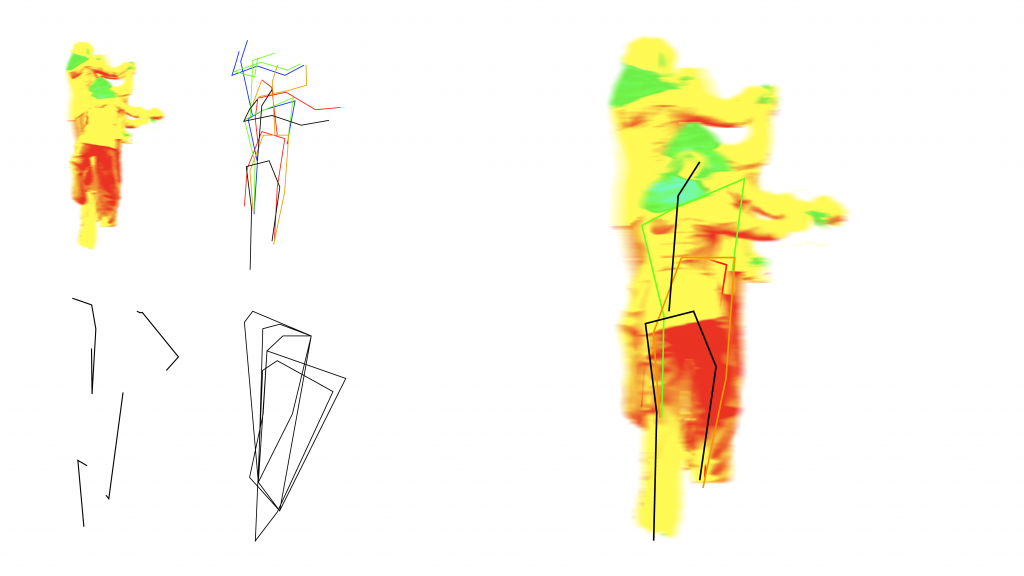
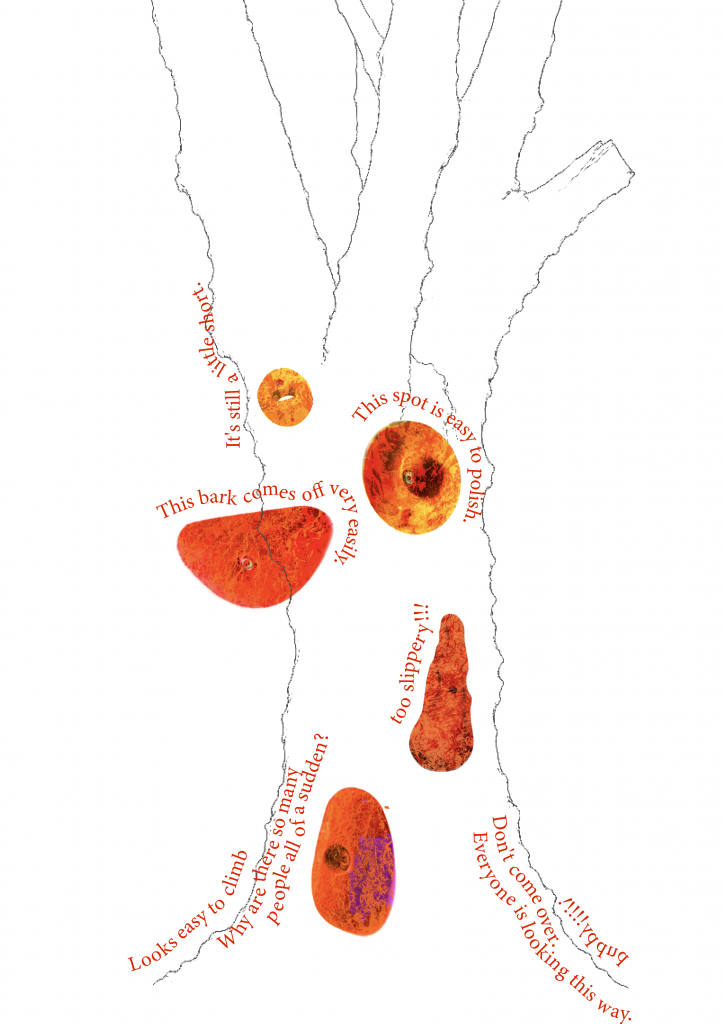
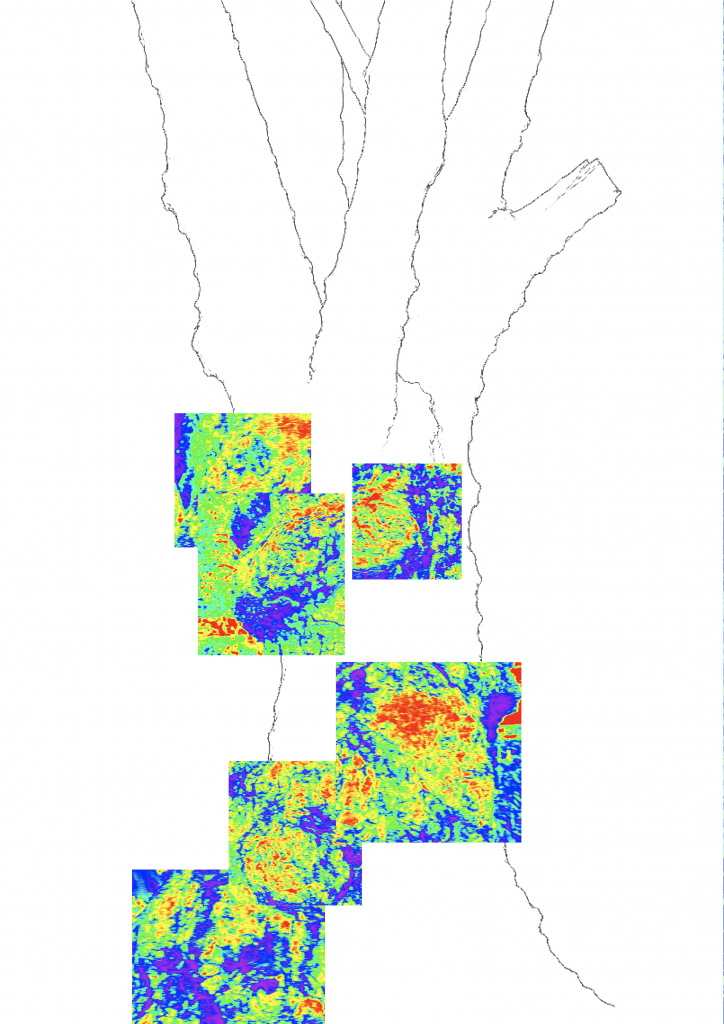
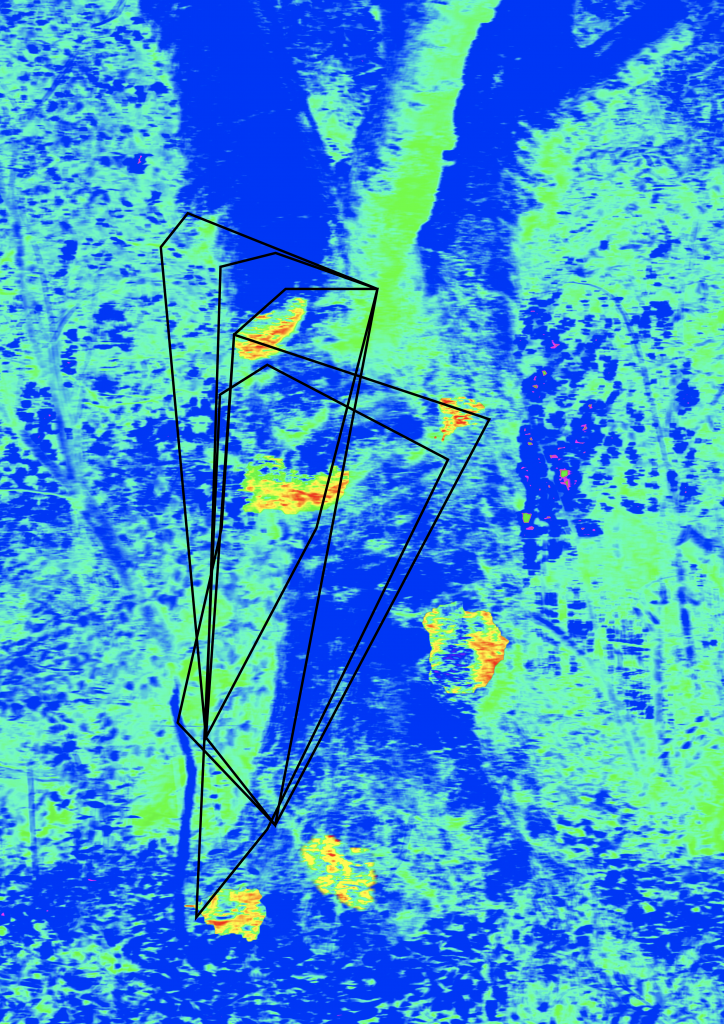
    Afterwards, I began to explore the characteristics of the tree itself, from the texture of its bark to the bumps and shapes of its trunk. This made me suddenly wonder: what if I climbed this tree? Many of us have experienced climbing trees as children, but we rarely stop to think about why we climb trees, how we manage to climb them, or which features of a tree make climbing possible. In The Street, Perec (2008, pp. 50–53) asks observers to repeatedly record, classify, count, and wait. He even describes the small actions involved in a driver parking a car. Inspired by this approach, I began climbing the same tree repeatedly, changing the positions of my hands and feet to explore different and potentially better ways of climbing it. I then used photography, handwritten notes, and video recordings to document the process. I recorded the positions of my handholds, how I felt at particular moments, how I gripped different parts of the tree, and how I distributed my body weight. In Mapping It Out: An Alternative Atlas of Contemporary Cartographies, Tehching Hsieh’s map of Manhattan (Obrist, 2014, pp. 74–75) made me think differently about how I could record my climbing experience. Instead of seeing a map simply as a tool for showing locations, I began to consider how lines and marks could represent physical movement. Instead of seeing a map simply as a tool for showing locations, I began to consider how lines and marks could represent physical movement. In my project, I recorded the positions where my hands and feet touched the tree and connected these points to show different climbing routes. This helped me realise that a tree is not only a physical object, but can also be understood as a space shaped by my body’s movements and interactions with it. Eventually, I decided to experiment with thermal imaging as a way of mapping my movements and presenting the climbing process. Of course, my research involved many stages of experimentation and iteration. At first, I simply photographed the points where I climbed and wrote down what I was thinking and feeling at the time. However, I gradually realised that photographs had limitations. They could show the positions of my hands, but they could not fully represent the interaction between my hands and the tree, or clearly demonstrate the different ways I gripped it. I then tried drawing and close-up photography to record these details. Eventually, I chose to experiment with thermal imaging because I thought heat could be transferred from my hands to the tree through repeated contact. In theory, this could reveal not only where I touched the tree, but also suggest how often particular points were used, making it an interesting way to visualise my climbing behaviour. At the same time, I used drawings of my body positions on the tree to show the movement process more clearly. Through these experiments, I began to understand that climbing could become more than a physical activity. It could also be a method of observing, recording, and understanding a space through direct bodily experience.

  • Methods of Investigating — Initial Observation

    Methods of Investigating — Initial Observation

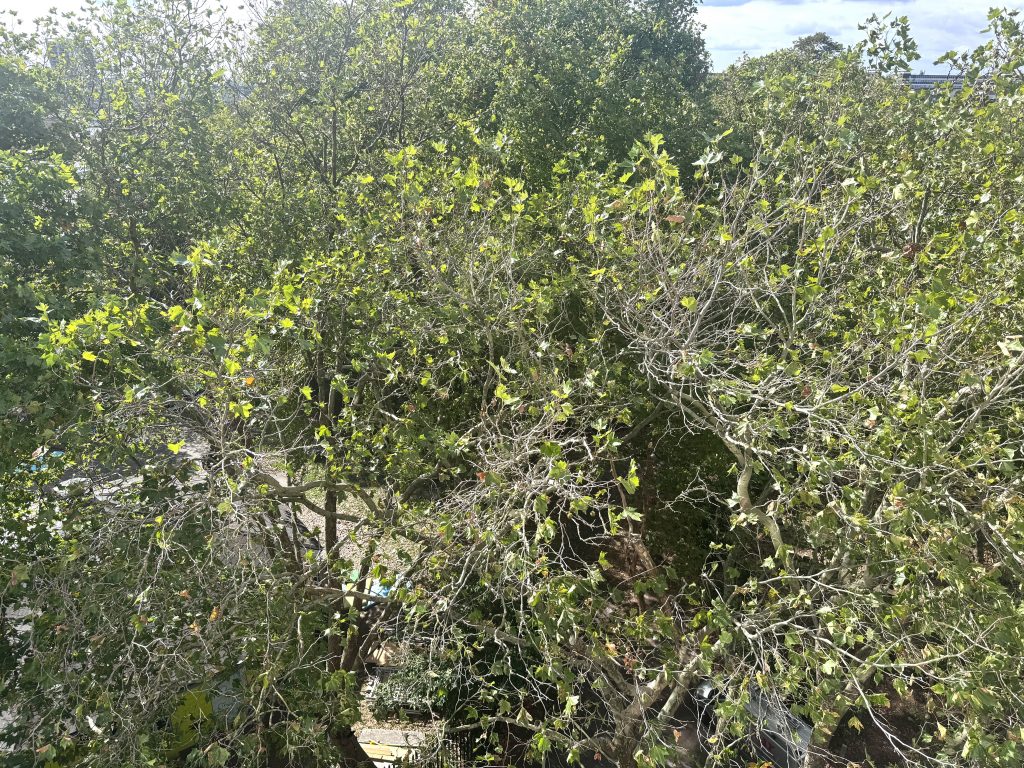
    I decide set my space on a tree. there is a tree near my balcony, I love it. When sunshine come in, it is so beautiful. So I decide to research that tree.

  • Hi, there is Ty’s blog

    this is my first time to use it. this blog will show u my creative process, maybe the progress for my English!!!

  • Hello world!

    Welcome to myblog.arts. This is your first post. Edit or delete it, then start blogging!