Written Response
1
Beeswax is my main medium, while melting, dripping and solidifying are the processes I use to create my work. I want to explore what happens to the material when I repeat the same actions again and again. What can I control, and what is beyond my control?
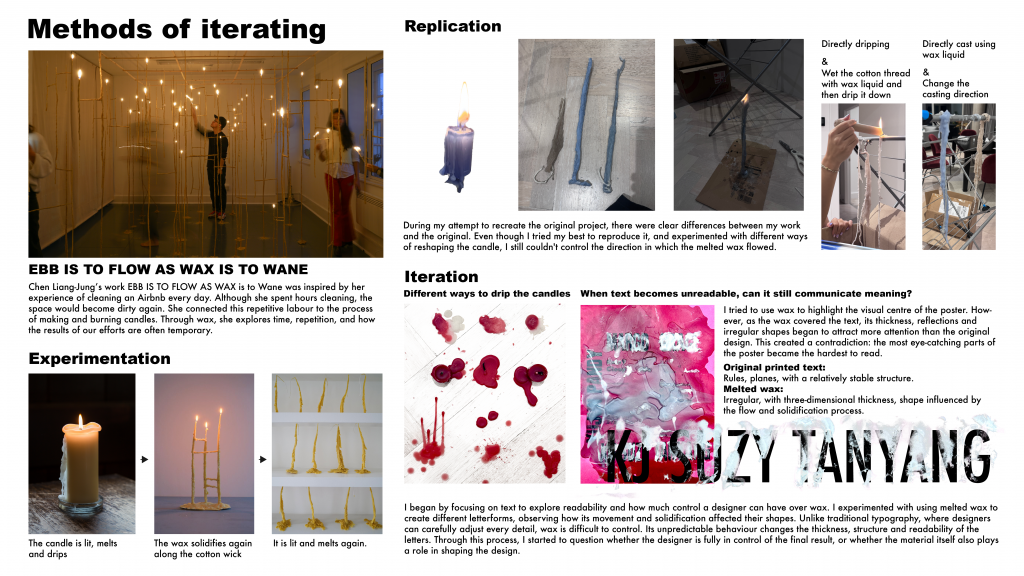
At first, I thought that when liquid beeswax flowed along a cotton string, it would form a relatively even and regular column. However, through experimenting with this process, I realised that the way beeswax flows and solidifies is difficult to fully control. Even when I repeat the same steps, differences in the amount of wax, temperature and where the wax is applied can lead to different shapes.
What interests me is that these irregular marks are not necessarily failures. Instead, they can become the most interesting features of the work.
Through studying Liang-Jung Chen’s work, I began to realise that wax is not just a material. The process of changing its physical state can also become a way of creating. Wax flows when heated and solidifies when cooled. This means that the final shape does not always have to be completely decided by the maker in advance. Instead, it can gradually develop through the interaction between the material and time.
This made me question whether design always needs to begin with a fixed final form, or whether the material itself can also play a role in shaping the result.
For my next stage, I plan to repeatedly burn and reshape the wax candles. I want to explore how repeated actions influence the material’s form by using different shapes to represent different making times and numbers of repetitions.
2
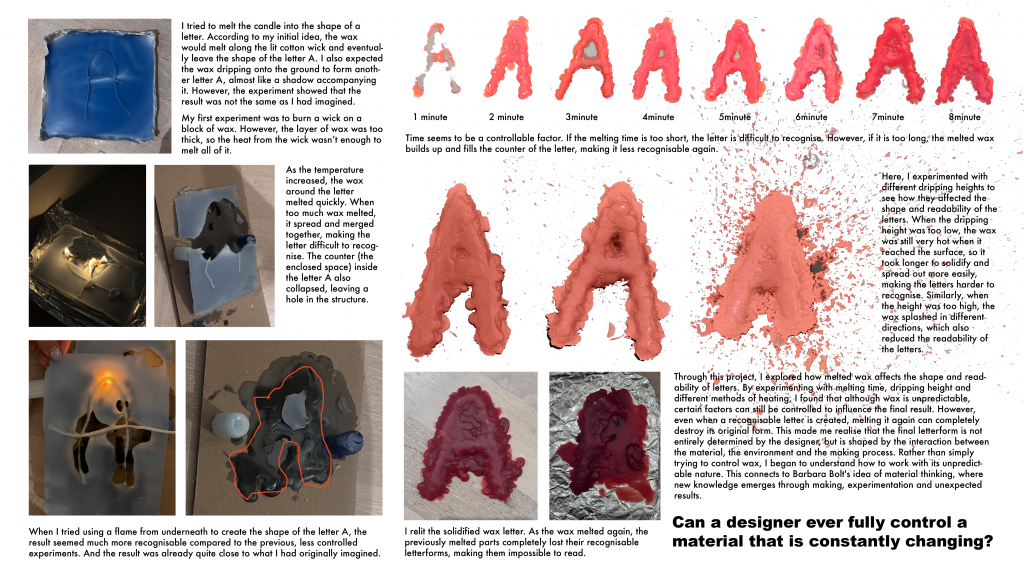
Inspired by Chen’s project, I started thinking about how the melting and solidifying of wax could be used in type design. I tried placing a wick directly on the surface of a block of wax and lighting it, to see how the heat from the flame would change the original shape of the wax.
During the experiment, I realised that the melting, flowing and solidifying of wax can create some really interesting visual marks, as well as changing the material itself. This made me wonder: instead of designing letters beforehand, could I develop a new typeface by exploring the shapes that naturally emerge during the burning process?
I also want to explore how the structure, visual appearance and legibility of letters might change when their forms are influenced by the material and physical processes, rather than being completely controlled by the designer.
My first experiment was to burn a wick on a block of wax. However, the layer of wax was too thick, so the heat from the wick wasn’t enough to melt all of it.
I then tried using a thinner layer of wax, but it burned too quickly and didn’t leave many visible marks. So, I’m still experimenting to find the right balance.
I also tried another approach, which was to use a flame to melt the wax into letter shapes. I found this method really interesting. Visually, the melting process was fascinating because the wax layer was so thin that I could actually see the wax melting as it happened.
However, I haven’t yet figured out how to develop this into a broader visual exploration.
I’m also really interested in the letter shapes created in the melted wax itself, as well as the shapes formed by the wax dripping onto the surface below. I think both of these could be interesting starting points for further experimentation.
After reading the reference literature, I began to explore how answers can be found through practice. During my experiments, I realised that wax is an unpredictable material that exists in two different states. It is difficult to make wax behave exactly as we intend. We cannot fully control where it solidifies or what shape it will take.
As Heidegger suggests, we do not first come to understand the world through theoretical reflection. Instead, we develop an understanding of the world through practical engagement before we can understand it theoretically. New knowledge can therefore emerge through our interactions with materials, methods, tools and ideas (Heidegger, cited in Bolt, 2007).
Based on this idea, I decided to explore wax in its different states by experimenting with factors such as the height from which it falls, the speed of movement, burning time and the angle of the paper. Through these experiments, I hope to develop a deeper understanding of the material.
This connects to Bolt’s discussion of material thinking, which suggests that knowledge does not always exist before making, but can emerge through direct engagement with materials, failure and repeated experimentation (Bolt, 2007).
For example, in traditional type design, we usually decide on the shape of a letter before using tools to create it. When designing typefaces, we consider legibility, counters, stroke weight, proportions and structure. This often involves a long process of adjustment, because traditional type design places importance on creating a consistent and functional system.
However, when I use wax as a tool for making letterforms, I lose much of my ability to control these details. Liquid wax does not easily allow me to create sharp corners or precise counters. I cannot maintain an even stroke weight, and when too much wax builds up, the letter may even become unreadable.
I am not sure whether this can still be called type design. However, through this experimental process, I have begun to realise that the letterform no longer exists entirely according to my intentions. Instead, it is shaped by the interaction between myself, the wax, physical conditions and even the surrounding environment.
This leads me to another question: What happens to the meaning of text when it is created in this way?
Text no longer seems to function only as a medium for carrying and communicating human knowledge and culture. Instead, it begins to feel like something with its own agency, capable of expressing itself beyond the designer’s complete control. If the material has a role in shaping the letterform, where does the designer’s authorship begin and end?